
Starting a business often begins with excitement… and then reality kicks in. Suddenly, you’re thinking about branding, websites, money, content, emails, and systems. Now your to-do list explodes overnight.
Here’s the good news: you don’t need a big budget to get started. There are so many free tools that can help you build, test, and grow your business step by step. No pressure, and no perfection required. You can start for free and test it out at your own pace.
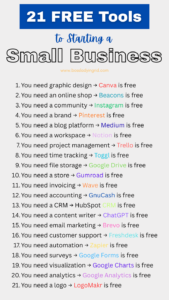
Below you’ll find the free tools that cover the basics of starting a business, explained in a practical way. These 21 FREE Tools support your small business journey.
Disclosure: This post may contain affiliate links, meaning if you decide to purchase via my links, I may earn a commission at no extra cost to you. Please read my disclaimer for more info.
Starting a Business: Building Your Brand & Online Presence
1. Canva – Graphic design
Trust me, Canva is your best friend as an entrepreneur! If design scares you, Canva will feel like a relief. It makes creating visuals simple, even if you have zero design background. Logos, social posts, Pinterest pins, lead magnets: it’s all there. You can start with templates and slowly find your own style. This is perfect when starting a business, and you want things to look good without spending hours (or money). Also great for creating your social media posts!
2. Beacons –Online shop
If you’re looking for a great link-in-bio shop, you need to try Beacons.ai. It’s forever free to use and looks amazing, with many options to start your business online. It’s easy to use for beginners. You can read more about the benefits of a Beacons store in this blog.
3. Instagram, Facebook & Threads – Social media
The best thing about social media is that it’s free to use for everyone. Facebook remains the world’s largest social media platform with over 3.07 billion monthly active users. Instagram has 2 to 3 billion monthly active users, and Threads (also part of META) has over 400 million monthly active users and is growing fast. This means there are a ton of potential customers out there, looking for whatever you are selling. Building a community online builds trust and a strong brand. Women who have made a lot of money on social media are the creators of these online courseswhere they teach you how to build and grow your business, too.
4. Pinterest & Twitter (X) – Branding & visibility
When you’re starting a business, people don’t magically know you exist. Twitter is a great place to share ideas, thoughts, lessons, and even doubts along the way. You don’t need to be “an expert” here; you just need to be real. Showing up consistently builds trust over time, and trust is often what turns followers into clients. Think of it as practicing being visible without pressure. Pinterest is also great to start using, because you don’t need followers, and your pins will remain visible for many months. Pinterest isn’t a social media platform; it’s a search engine, like Google, but with images.Learn more about Pinterest marketing in this blog.
5. Medium – Blogging platform
If you love writing but don’t want to deal with websites yet, Medium is a great place to start. You can publish articles, share ideas, and build an audience without worrying about tech. It’s perfect when you’re testing business ideas or simply want to practice sharing your thoughts publicly while starting a business.
Tip: If you do want to make money blogging in the future, it’s best to start with a WordPress blog (costs about $35 per year). This blog can be monetized, and it may be worth the investment right now. Read more about aWordPress blog in this tutorial for beginners.
Save this image on Pinterest
How to Start a Business Without Feeling Overwhelmed
6. Notion – Planning & organization
Notion is like a digital brain that actually listens. You can use it to plan content, map out goals, track ideas, or organize your entire business in one place. When starting a business, your head can feel full all the time, and Notion helps you get things out of your head and onto a page, which is oddly calming.
7. Trello – Project management
Trello is simple, visual, and perfect if long to-do lists stress you out. You can move tasks from “to do” to “done” and actually see progress happening. When learning how to start a business, that visual reminder that you’re moving forward is incredibly motivating. You can also work with others. I use it for writing texts and planning posts for my social media. I can easily copy and paste it to Instagram and plan ahead for the coming weeks and months. It’s very easy to use.
8. Toggl – Time tracking
Time tracking sounds boring, but it’s surprisingly helpful. Toggl shows you where your time actually goes, not where you think it goes. When starting a business, this can help you stop overworking and start focusing on what really matters. This might be very helpful in the beginning, to prevent feeling overwhelmed.
9. Google Drive – File storage
Google Drive keeps all your files safe, and it’s easy to access. Documents, images, spreadsheets, it’s all in one place. It might seem basic, but good organization early on saves you a lot of frustration later. You can store everything you wrote for your website, blogs, social media, and email marketing. It feels good to keep a copy of everything, just to be safe.

Start a Business and Handle Money with Confidence
10. Gumroad – Selling products or services
If you’re wondering how to start a business without getting lost in complicated platforms, Gumroad is a real lifesaver. It makes selling simple and approachable. Whether you’re offering a digital product, an e-book, a course, or a one-on-one service, Gumroad allows you to set everything up quickly. What’s great is that it’s perfect for testing small business ideas before fully committing. This means you can experiment, see what works, and adjust without risking too much. It’s like a little confidence boost in your inbox every time.
11. Wave – Invoicing
One of the trickiest things about starting a business is actually getting paid, and doing it in a way that feels professional. That’s where Wave comes in. It allows you to create and send clean, professional invoices without feeling awkward or unprepared. Even if you’re just starting and your business is tiny, having a solid system for invoicing gives you peace of mind. It also shows clients that you’re organized and trustworthy. The bonus? It saves time compared to trying to create invoices manually. Trust me, when your first invoice lands and the payment comes in, you’ll feel a little victorious!
12. GnuCash – Accounting
Let’s be honest: accounting can feel intimidating. But GnuCash is here to make it manageable, and even empowering. It helps you track all your income and expenses clearly, so you always know exactly where your money is going. When you’re starting a business, having that clarity can reduce stress more than you might expect. No more guessing or panicking about finances, because you’ll have real insight into how your business is performing.
13. HubSpot CRM – Customer relationships
As your business grows, it can be surprisingly hard to remember every conversation you’ve had, every follow-up you promised, and every potential lead. HubSpot CRM solves that problem beautifully. It keeps all your contacts, conversations, and tasks in one place, so you never have to rely on sticky notes or memory alone. For someone starting a business, this is invaluable. It helps you stay organized, respond on time, and nurture relationships. This is exactly how small businesses build trust and loyalty. Essentially, it’s like having a personal assistant who remembers everything for you.

Business Ideas Need Marketing to Grow
14. ChatGPT – Content support
We’ve all been there, staring at a blank page, with zero ideas and a growing to-do list. That’s where ChatGPT comes in like a creative sidekick who’s always ready to help brainstorm ideas, draft texts, or even organize your scattered thoughts. It’s not here to replace your unique voice, but to support and inspire you when your brain just needs a little nudge. Especially on those low-energy days when your business still needs content, ChatGPT can be a real lifesaver.
15. Brevo & Beehiiv – Email marketing
Email might sound old-school, but it’s still one of the most powerful ways to build genuine relationships with your audience. But I get it, setting up email marketing can feel overwhelming with all the tools out there. That’s why I love Brevo and Beehiiv: they make sending newsletters simple, even if you’re just starting out. You can build your mailing list step-by-step without complicated tech. The best part? You’re showing up directly in your people’s inbox, which builds trust and keeps them coming back.
16. Freshdesk – Customer support
When customers have questions (and they will!), good support makes all the difference. Freshdesk helps you manage and respond to inquiries clearly and professionally. Think of it like having an organized inbox just for your business conversations. Great customer support builds trust, and trust is the foundation of a lasting business. Even if you’re still small, showing you care through prompt, helpful replies sets you apart and keeps people coming back.
17. Zapier – Automation
Starting a business often feels like juggling a million tasks at once. Zapier is like your dependable assistant who quietly takes some of those tasks off your plate. It connects different apps and automates repetitive actions (like saving contacts automatically or sending thank-you emails after purchases) all without you lifting a finger. This not only saves you loads of time but also frees up your mental energy, so you can focus on what you truly love about your business. If working smarter instead of harder sounds good to you, Zapier is a game-changer.

Small Business Ideas Grow with Insight
18. Google Forms – Feedback & surveys
When starting a business, it’s easy to fall into the trap of guessing what your audience wants. Instead, why not ask them directly? Google Forms is an incredibly simple tool to create surveys and collect feedback. Whether you’re testing a product idea, checking if your content resonates, or simply learning more about your audience, Forms makes it easy. You get clear, real-world answers that help you make smarter decisions instead of relying on guesswork. I love using it because it feels like having a mini focus group without leaving your desk. Plus, your audience often appreciates being asked for their opinion.
19. Google Charts – Visual data
Numbers can be overwhelming, especially when you’re starting a business and trying to make sense of results. That’s where Google Charts comes in. It helps turn raw data into clear, visual graphs and charts, making patterns much easier to spot. Suddenly, insights that felt confusing become obvious. This is super helpful when deciding what’s working in your business, from sales trends to audience engagement. I personally find that seeing data visually makes decisions feel less stressful and more actionable. It’s like turning a foggy map into a clear roadmap for your next steps.
20. Google Analytics – Website insights
When you first launch your website, it’s tempting to obsess over traffic numbers. Don’t! Google Analytics is here to give you perspective and real numbers. It shows what’s working, what’s not, and how people are actually interacting with your site. You don’t need to check it daily, but just use it as a compass to guide your next moves. I like to check it weekly, knowing what content resonates with my visitors helps me to see what works and what doesn’t work.
21. LogoMakr – Simple logos
Not ready to hire a designer yet? That’s okay, you can still create a professional-looking logo with LogoMakr. It’s simple and perfect for testing your brand identity when starting small. You can play around with fonts, colors, and symbols until it feels right. Remember: your logo can evolve as your business grows. I often tell new business owners to treat this as a fun experiment rather than a permanent stress point. Your logo is just the start of your visual story, not the whole chapter.
Taking It One Step at a Time
Starting a business isn’t about doing everything perfectly or having it all figured out from day one. In fact, that’s a fast track to feeling overwhelmed and stuck. Building a business is more like a puzzle: there are a lot of pieces, and they don’t all have to be in place at once. What really matters is taking small, clear steps and using the tools that support you right now.
Remember, progress comes from consistency, not perfection. You don’t need to set up every system, master every tool, or have a complete plan before moving forward. Start with one thing, and maybe a tool from this list that excites you or a task you’ve been avoiding. You can try it today! Just one. Then build on that momentum slowly, step by step. Over time, those small actions add up to big results. This way, you get to enjoy the process along the way.
Starting a business is a journey, not a sprint. Permit yourself to take it one step at a time, celebrate the wins (even the tiny ones), and trust that clarity, confidence, and growth will come as you go.
Curious how to start a business the best way? Make sure to also read How to start an online business.